HELIXsystem
Process Assembler
The HELIXsystem unites Artificial Intelligence with Digital Twin technologies
Patented Technology
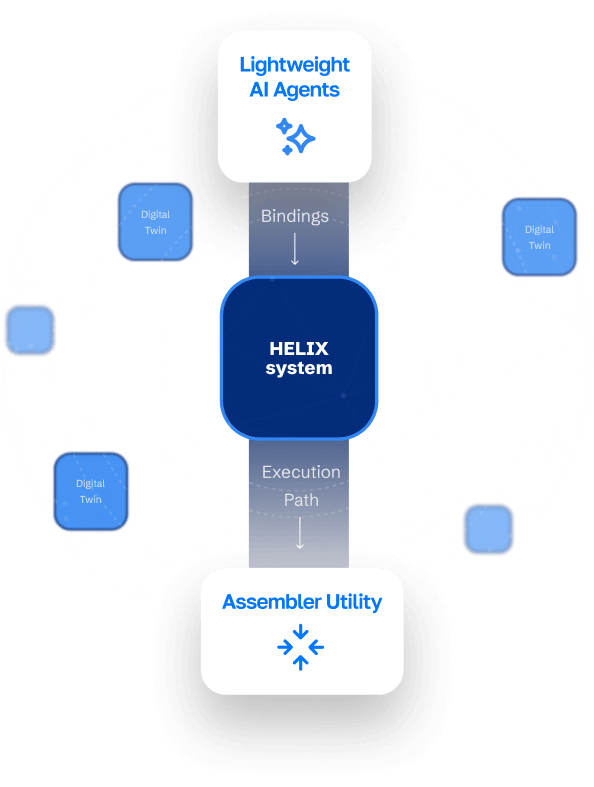
The HELIXsystem is comprised of two components, the Client Utility and the Assembler Utility
The Client Utility is owned and controlled by the client. The Myrror Corporation does not install any proprietary software on the production environment
The Assembler Utility runs in its own environment completely decoupled from both the Client Utility and Production. This enables the Assembler Utility to be implemented without any impact on the live implementation
The Client Utility is owned and controlled by the client. The Myrror Corporation does not install any proprietary software on the production environment
The Assembler Utility runs in its own environment completely decoupled from both the Client Utility and Production. This enables the Assembler Utility to be implemented without any impact on the live implementation
24/7/365 fully automated system and behaviour capture
Continuously updating Digital Twin of live implementation
Ultra high precision with ultra low latency
Bi-directional system and Digital Twin synchronisation
Technology Overview
HELIXsystem Process Assembler
Deploys across any large scale environment regardless of complexity
Architecture
The Process Assembler is comprised of two components, the Client Utility fully owned and controlled by the client and the Assembler Utility hosting Myrror Corporation’s patented technology
Bi-Directional Synchronisation
The HELIXsystem Digital Twin is continuously and bi-directionally synchronised with the live environment providing a real-time representation of what the system is actually doing
Captures the System’s Syntactic Bahaviour
Captures the ‘edges’ of process execution. How and when messaging events are sent and received
Captures the System’s Semantics
The HELIXsystem delivers real-time observability of the system’s parts, how these interact, the properties they exhibit. This provides end-to-end observability of the source and destination of data and how data is generated and changed as it transitions across a complex environment. This bridges the gap between simply providing a diagram of how a process executes to providing real-time observability of the system’s actual behaviour
Delivers a Digital Twin of the Live Implementation
The HELIXsystem Digital Twin is a real-time, continuously updating graphical ontology of the actual system, capturing all system behaviour whether this executes sequentially, or with overlapping timestamps
Why This Matters
The introduction of Artificial Intelligence is resulting in a technology generational shift.
This will see existing systems transition from collections of silo’ed business functions to becoming unified data management platforms.
This transition will be necessary to meet the demands for “Always On” data required by
the new AI engines
“Always On" data imposes new demands for system reliability, scalability and performance. To meet these new demands, a new control plane will be required. This control plane will be the Digital Twin of the live implementation providing “Always On" observability over how data is generated, transformed and transmitted
Without this control plane, an “Observability Gap” will open between the what system administration thinks the system is doing and what the system is actually doing
“Always On" observability enables bi-directional synchronisation to be introduced. This enables system changes to be simulated in the Digital Twin prior to change being introduced to Production. Once a change is introduced to the live system, the Digital Twin monitors the live implementation and compares the observed activity against the simulated behaviour to ensure a variance does not arise
“Always On" data imposes new demands for system reliability, scalability and performance. To meet these new demands, a new control plane will be required. This control plane will be the Digital Twin of the live implementation providing “Always On" observability over how data is generated, transformed and transmitted
Without this control plane, an “Observability Gap” will open between the what system administration thinks the system is doing and what the system is actually doing
“Always On" observability enables bi-directional synchronisation to be introduced. This enables system changes to be simulated in the Digital Twin prior to change being introduced to Production. Once a change is introduced to the live system, the Digital Twin monitors the live implementation and compares the observed activity against the simulated behaviour to ensure a variance does not arise